
https://nordpil.com/static/images/ocean_productivity_full.png

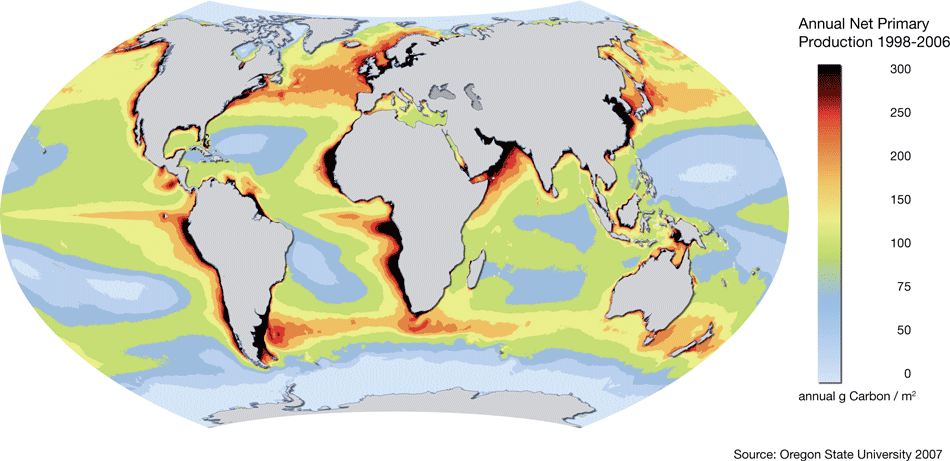
A picture’s worth a thousand words. By far the most productive regions of the ocean are the shallow waters of the continental shelves. Maybe you could have an ocean world that was entirely shallow seas. But when I imagine an ocean world, I imagine abyssal depths spanning an entire planetary surface. Such a world would have far less ocean abundance than our own.
It wouldn’t be a complete desert. Plenty of life does exist far from the continental shelves. It’s just that these are the most productive regions of the ocean.
The problem with life is you need more than just water. Living things are mostly water, but the water is the boring part. And a lot of the essential building blocks of life tend to fall out of the water column as marine snow.
In shallow water, the depths that light can penetrate can also interact with the ocean floor. This allows more churning of vital materials. Plus there is a constant flow of new minerals and nutrients flowing in from the land.
In a deep ocean world? There would be very few minerals and nutrients available at any depth light could reach. Some would still work its way up through the action of currents, but nothing like the shallow waters.
And then you have to consider the nightmares Nature spawns, with terrors beyond any found in our oceans. A neat thing happens with oceans if you make them too deep. Pile enough water on top of water, and exotic high-temperature ices form under all that pressure. Some Super-Earths host oceans of scales beyond comprehension, but they are vast deserts made of water. If you kept piling water on Earth’s surface, once the water got about 600 miles deep the exotic ices would start to form. This depth will vary based on the size of the planet, but for any given size, passed a certain point, the ocean has ice at the bottom.
And that is a problem for life. The water column is now cut off from the planet’s crust. Volcanoes might periodically spew out some material through the ice shell, but we’re already talking low-productivity worlds to begin with.
Now a shallow ocean world, a planetary continental shelf? THAT would be something to behold. But such worlds should be rare. Your ocean depth has to be tuned just right. On the scale from “mile’s deep ocean” to “planetary desert,” a planetary 100-foot deep ocean is just to the left of being a planetary desert.


We already have sentient carp. Or at least, sentient denizens of the deep.
We already have that here.
Sperm whales communicate with each other in a language as complex and information-dense as our own. It is reasonable to assume they are sentient. We are not discussing the hypothetical sentience of matrix math on silicon chips here. We’re talking about another biological entity, with a brain of the same fundamental nature as our own, with a brain much larger than our own, of common evolutionary heritage to our own. And by what other objective measure could we use to measure the sentience of another biological mind, than the complexity of its communication? You could look at behavior. But they’re complex social mammals just like we are.
If we are sentient, so are they. I’m sure they have thoughts and as complex of inner lives as we do.
I wonder what their culture is like. Do they tell stories of great hero whales of the ancient past to their children?
Or are they more learned? Are they down there debating the finer points of philosophy like Plato and Aristotle? They couldn’t do anything experimental. Perhaps they would become masters of classical philosophy.
Perhaps, more ominously, if we can learn to talk to them…what will they want to tell us? I wonder if they still have a cultural memory of the whaling days. Are there sperm whales alive today who hear tales from their elders about the time humans ruthlessly hunted their kind? Do they doubt they are real, wondering if they’re merely old superstitions? These seem so different from the humans you know. (Mostly.)
Or would their culture be so different, that none of these concepts would even remotely map to the things cultural touch stones I cite?