• 7 Posts
  • 203 Comments
Joined 4 months ago
cake
Cake day: April 27th, 2026

help-circle

  • He’s been crashing out since the Mecca Joint Defence Agreement was signed between Saudi Arabia, Pakistan and Turkey.

    Saudi Arabia and Pakistan had already made an earlier defense agreement with each other about a week after Qatar was bombed by Israel, which theoretically puts Saudi Arabia under Pakistan’s nuclear umbrella. Now with Turkey in that brings aboard a rather large military with NATO standards… and one that has mutually terrible relations with Israel.

    For a while Israel has been angling to pull in Saudi Arabia on the other more Abraham Accords side of things without giving into the Saudi condition that they first start an irreversible path to establishing Palestinian statehood before normalizing relations but Saudi Arabia taking this step with Turkey shows rather publicly that those efforts have been frustrated.

    Amichai also urged Israel to deepen alliances with Greece, Cyprus, the United Arab Emirates and the otherwise unrecognized government of Somaliland as a counter. Obviously Greece and Cyprus pin down Turkish forces to their west and on Cyprus to limit what Turkey could hypothetically bring to bare against Israel. To those who don’t know the UAE and “Somaliland” may seem kind of random. But the UAE has been supporting a lot of coups, civil war factions and so on whenever there’s instability in the region and doing heavy investments in Africa. So the UAE has considerable sway in Sudan via the RSF, Somalia via supporting Somaliland and Puntland, Haftar in Libya (who has allowed eastern Libya to be used as a channel to funnel weapons into Sudan even over protests from Egypt), and so on. Even paying Ethiopia to train RSF rebels and fire drone attacks into Sudan.

    As Turkey and Saudi Arabia are invested into the existing recognized governments of Somalia and Sudan, this splits their focus and could force them to have to pick and choose among their various projects or still try to support them all but be less likely to succeed.

    Unfortunately for Syria the proximity to Israel and being under Turkish influence also means that when Israel wants to lash out against Turkey, it is very easy to do that by harming Syria. When Syria was fresh out of the revolution Turkey tried to send personnel to evaluate existing air bases so that Turkish airforce could be stationed there and Israel reaponded by bombing those bases over the entire country and destroying the Syrian airforce. Syria invaded the UNDOF buffer zone and claimed the heights of Mount Hermon which gives it huge unblocked range for what it can see and respond to with radar. When the Suwayda clashes happened, Israeli issued demands to demilitarize southern Syria and began airstrikes to destroy the government forces sent to the area (plus an airstrike on the presidential palace in Damascus), allowing Hijri’s forces to consolidate their power in Suwayda and remove the local Bedouins. Sharaa can’t do much of anything about it by himself because his military is not even large enough to properly restore order in all of Syria with all the militia running around. Trying to concentrate enough forces to ward off Israel (a tall task indeed) means some areas will get stretched. If security is too stretched in an environment with a huge number of people out for revenge killings, a provocation that overwhelms local professional forces in an area (ex. like the ambushes at the coast) could easily spiral out into massacres again as the trigger-happy militia running around in to settle scores. And such massacres further stoke sectarian tensions to make a repeat easier and makes it harder for other governments to support Syria, so either way Israel is winning.

    Anyway any guesses on this guy’s reaction if the rest of the faction can talk Egypt into signing onto the Mecca Joint Defence Agreement? Egypt is also invested in protecting Eritrea, Sudan and Somalia’s existing governments; they do not want Ethiopia growing overstrong by cheaply accessing ports out of those countries lest a powerful Ethiopia use the leverage of the Nile River to make Egypt so whatever it wants. This was important enough to flip Egypt out of alignment with the UAE which had backed the military coup against the elected government. And the worse Israel acts in Palestine, the worse the pressure of the enraged people becomes on the government of Egypt for their existing ties with Israel. So although Egypt is kind of the odd man out among Turkey, Pakistan and Saudi Arabia they have all been acting more and more closely despite their differences.


  • The average is higher but so is the median. A lot of the densely packed slums in US cities were physically destroyed which got rid of a lot of the homes that had very very small space per person, and newly built homes in the ever expanding suburbs after the roads were built out take up much more land and space is at less of a premium than in the cities where the land was very expensive and required building up and new construction standards were significantly higher than they had been.

    On the good side this meant that families with a home had more space to spread out in, on the downside the destruction of the slums made it much more expensive to live in the cities with everyone competing for the remaining bigger homes and brought down the urban core populations (Manhattan is still down ~700000 prople from the peak of its population in the early 1900s) and the physically spreading out into the suburbs requires much morr inefficient infrastructure, more environmental impact, etc. Urban people who may have in olden times still been housed in cheap tenement slums now go without and are homeless because there’s a cliff between the streets and the most affordable housing whereas the slums used to make it a more gradual slope.


  • The primary goal of it is containing Israel, note that the preceding Strategic Mutual Defense Agreement between Saudi Arabia & Pakistan was rushed through just over a week after Israel bombed Qatar. That caused a lot of alarm bells to ring in Saudi Arabia because Qatar has the largest US base in the region (Al Udeid Air Base) and while Israel justified it by saying they were targeting Hamas leadership there, the US were the ones who told Qatar to invite the leadership of Hamas in the first place. (It’s much more comfortable for American & Israeli diplomats to talk with Hamas officials in Doha, Qatar than out of Iran [which has taken previously taken American diplomats hostage] where they were based before.) So Qatar was basically doing as much as it could to back America and had even personally bribed Trump with the massive plane but America still let Qatar be bombed by Israel with very limited repercussions, which makes relying on the US for security look foolish to actors in the region.

    Nevertheless, all in this pact (plus others not formally in but still on board with the faction like Egypt and Qatar) still maintain fairly decent relations with the US (and Trump in particular) and are happy to buy American weapons and so on, so to be clear it’s not really angled as a “US out” sort of alliance at all at this point. The inclusion of Turkey makes this very clear since Turkey is having a re-approachment with the US to obtain the F-35 but Israel has been propagandizing against Turkey as “the new Iran” heavily.

    Other aims include countering the UAE, India, Greece and Ethiopia who are in an emerging faction with Israel. The UAE sees Islamists as an existential threat and has been backing coups and civil wars to get more secular alternative governments in power whether through outright flipping or fragmenting existing states. Ex. backing authoritarian Haftar’s side in Libya, the military coup in Egypt (though their relations later deteriorated), South Yemen separatists for splitting from Yemen (though Saudi Arabia recently squished them), Somaliland and Puntland in splitting from Somalia, and the Arab supremacist RSF in Sudan. If this all worked then that faction would have held sway over a massive chunk of Africa from Libya down through both chokepoints of the Red Sea and that would have been fantastic leverage over Saudi Arabia with the UAE parked at their only other sea export route. Ethiopia for its part wants access to the ocean for cheaper than Djibouti offers its portsfor and so has been saber rattling against Eritrea and providing support for the UAE in trying to flip Sudan and partition Somalia. (Note Egypt is scared of a powerful Ethiopia capable of throttling the Nile River since almost everyone in Egypt lives on the banks of that river so that led them to flip sides to try to keep Ethiopia from nabbing ports and becoming that powerful.) India of course opposes Pakistan’s efforts as their rival and has been massively expanding gas from the UAE while furthering strategic partnerships with Israel and Ethiopia as well.

    Regarding Iran, I think Saudi Arabia would like the pact to be against them as well but I don’t think the other members are as interested in that. Pakistan’s economy is terrible and their only friendly neighbor right now is Iran so they’d prefer Iran be intact and not a chaotic place where their mutually shared separatists can grow strong dancing around the border. Turkey had some friction before in Iran supporting Assad’s Syria but with Assad & Hezb both out of Syria Turkey would prefer to focus on things they have in common like supporting Palestine and the recognized government of Sudan, plus their economy has had some difficulties and there are shared Kurdish militants on the border so again not wanting Iran to get destroyed as that worsens the economy and makes shared separatists stronger. Saudi Arabia on the other hand is in the hot seat because it has been directly targeted by Iran (easy to do as they have few economic links and with no adjacent army there isn’t much Saudi Arabia can do to punish Iran that they aren’t getting way worse from the US) and they have competing proxies in Yemen, the Saudi-supported recognized government with most of the land but about the quarter of the population and Iran-aligned Ansar Allah (aka Houthis) with the bulk of Yemen’s population and a small but strategically important bit of land that can choke travel through the southern end of the Red Sea and provide a launching point for their very capable drones.

    With Saudi Arabia and Iran having terrible relations and competing proxies on Saudi Arabia’s doorstep while the others in the pact are invested in keeping things peaceful with Iran and trying to keep the focus on a shared disdain for Israel, I’m curious but hoping not to find out as to whether this pact will actually be enforced if Iran strikes Saudi Arabia again or if kind of nothing in military action comes of it and it looks flaccid like what happened with the SMDA when Saudi Arabia was bombed earlier and Pakistan mostly just kept championing the attempts at ceasefires.


  • The deal that Syria signed saved face for Russia by letting them maintain a foothold but in practice the most useful parts of the facilities are being transferred to Syria. Syria will take control of the civilian facilities at the Hmeimim airbase and the commercial section of the Tartus port. The military facilities are to be transformed into joint Russian-Syrian training centers.

    edit: think I misread your post. Yeah Assad lives or dies by Putin’s word but that’s been the case for a while. I think his personal value in anything he can physically do is way outweighed by his symbolic value. His continued existence is a symbol that Putin will stand by his international partners, but he’s also the textbook example of a psycho incompetent dictator so taking him to justice also has great symbolic value for Syria especially. He’ll be gone if Syria offers up something more valuable to Russia than that symbol of friendship to their partners around the world but, since he hasn’t disappeared yet, I guess the Syrian government has been balking at the cost of that hypothetical deal.


  • Maybe for a more high capacity state with a better handle on things, but it would be a bad idea for the Syrian government to publically declare such a thing. A huge part of the populace want Assad’s head and are already mad that the government isn’t acting more firmly against many former regime personnel. Many have been taking matters into their own hands with revenge killings being very common on the street. Publically saying that he gets life in prison will guaranteed cause riots and they don’t need to be stretched any more thinly. They have a fragile hold on power, relatively small professional forces who are very overstretched and huge numbers of trigger-happy militia everywhere. Outbreaks of violence that the disciplined forces can’t control spiraling out into massacres as militia rush in have been been disastrous not only for the bloody toll on the people but also for their integrity as a state and tanked external relations relative to what they could have been. So, they really don’t need to start optional riots that distract their forces and open them up to being hit with another provacation.

    Going this way instead they rather have people celebrating in the streets for basically a few words while Assad himself is safely out of reach at his gamer pad in Moscow. BTW him abandoning the country to keep playing Candy Crush safe under Putin has not done much to endear him to those aligned with him who had stayed behind to face Syria’s hostility, hard to make a martyr image out of that.


  • Now Turkey is officially onboard. The other most significant players in the block that haven’t tagged along are Egypt and Qatar although Egypt is a bit of the odd man out.

    This is mostly pointed at the faction including Israel and the UAE (plus Greece, India, Ethiopia etc…) but the Iran War puts a twist on things. Iran has intermittently bombed Saudi Arabia or had its proxies in northern Yemen attack them and its unclear if this pact will activate to protect Saudi Arabia against such things… those are the countries that Iran would least want getting involved in a war because they have powerful land armies right on the doorstep that can attack from opposite sides so maybe that gives Iran pause to attack Saudi Arabia, but those countries also really do not want war with Iran themselves as they have fragile economies and instability which is why they have been really involved with trying to negotiate peace. If some Iranian officer attacks without authorization and the pact is actually activated for it that could be a pretty big deal.


  • I just saw some of the video. Refers to a class action lawsuit and quotes from it heavily. The class action seems to not be alleging price fixing per se (meeting in a smoky room and determining price) but rather than they are colluding to all cut DRAM supply and profit from the price spiking since the demand is unchanged. Even to the point of forgoing profits.

    It doesn’t seem all that convincing though so I don’t think it will go anywhere. Something similar was tried a couple years back that was shot down by the courts. It’s not illegal for competitors in the market to behave similarly if they consider it in their rational interest to do so, it’s only illegal if they are cutting a secret deal for it so you have to have some good quality “plus factors” to convince the courts that some shady deal is going on. If there are reasonable alternatives to explain the behavior other than collusion then your case is kind of cooked.

    It’s easier if they have slack production that’s being left idle to point to (which still didn’t work earlier) but now they’re all trying to churn out as much HBM as possible for insatiable data center demand and are building new fabrication plants. The video said as one example that they have better margins on DRAM than HBM but while that may be true in the current state where everyone and their mom is focusing on HBM, one question that could be posed is would that remain the same if one of the major companies swapped focus? Like one of the three biggest gives up on chasing the AI money and stops making as much HBM to prioritize DRAM. That would cut the supply for the former and boost that for the latter, which would send prices up in what they just abandoned while crashing the prices into what they’re re-entering. They could secure a lot of market share in DRAM but that could be considered to be a sucker’s bet to sacrifice the foothold in HBM and enormous stacks of AI cash in exchange for cornering the market on an older technology. Also they are reaching agreements to make HBM at longer prices but for a guaranteed period of time which makes their margins on HBM weaker but also gives them confidence that they’ll be getting that smaller amount of money for sure even if we get an AI bust.


  • Nautalax@lemmy.worldtoGardening@lemmy.worldSurprise figs
    link
    fedilink
    English
    arrow-up
    1
    ·
    6 days ago

    I was so hyped to hear that wild strawberry was a very aggressive sun-loving plant practically capable of taking over lawns and bought myself some after seeds failed to take off. Unfortunately what I didn’t realize is that although they’re native I’m at kind of the extreme southern edge of their natural range (with some drought too) so I’ve been having to lean in and really give some support with water so that they don’t die (may also be stress from being transplanted near the start of summer). They make a valiant effort to daisy chain themselves around but the ones that get the afternoon sun will be limp with folded up leaves after just a couple days without supplemental water and the others while not so bad don’t look fantastic either and need to occasionally top-off. Not bothering to fruit much which I agree with. Plan to cut them all off of supplemental water next year when the roots should be better developed and let it go how it’ll go but pretty worrying…

    Also have the garden ones in a pot, those guys did fantastically and gave tons of delicious strawberries since they still has full sun but the potting soil doesn’t drain as easily as the loamy sand in the yard so no drying out.


  • Back in 1933 the US was on the gold standard. If the government wanted to print the money they had to have the gold to back it up so that it would be convertible to gold on request. If the economy grows but the money supply doesn’t then the existing money becomes more valuable which is deflation.

    Deflation sounds great - the money you already have can buy more! - but it can lead to a ton of economic problems. For example, if your money is becoming more valuable without you even doing anything, a temptation is to just do the equivalent of stuffing it under a mattress and to try to put off buying anything for as long as possible since the longer you can wait before buying anything, the more you can afford. That causes business to dry up because people are buying goods and services less frequently. So business revenues go down. Businesses with lost revenues have strong incentives to downsize by cutting their existing employment or reducing their wages. Those employees who are fired or with cut pay can’t spend as much which further reduces revenues. So that deflationary cycle keeps repeating and worsening the problem. In addition, consider loans and investment. Existing loans become more burdensome because they’re also worth more each day, so a lot of people will be defaulting because they didn’t expect the loan to be expensive. Those who lent the money can strike it rich if lucky or be ruined if unlucky so higher risk lending is disfavored in favor of low risk stuff like government bonds, similarly investments aren’t doing so great because so many companies are having worsening revenues so investing looks like setting money on fire and is less popular. No loans and no investment makes it extremely difficult to start or improve a business if you don’t already have money which means not many new startups are coming in to replace the folks downsizing or shutting down or come up with a new idea of doing things.

    So a lot of government efforts were put at the time in trying to beat deflation. The one this guy fell afoul of was that Roosevelt had by executive order suspended the convertibility of the dollar to gold and demanded that people with amounts considered in excess to take that excess to the government and be compensated for it for a defined exchange to paper money. That would get the government enough gold to make enough new currency so that it could pay for the many ambitious projects and programs Roosevelt envisioned to get the massive number of unemployed people back to work and making money so that they would buy goods and services and break the deflationary cycle. This guy however did not exchange his gold and had 160 kg of gold in a deposit that he was trying to reclaim (then valued at ~$100000 which is what we would now consider millionaire tier money), so he ran afoul of that restriction against hoarding. But if he had converted the gold to dollars earlier they would not have confiscated it. There’s no particular reason for the government to go around confiscating our accounts because there’s no gold in them, even if it were the dollar is no longer tethered in any way to gold, and even if that were the case we aren’t experiencing a deflation cycle that the government wants to create more money to break itself out of.


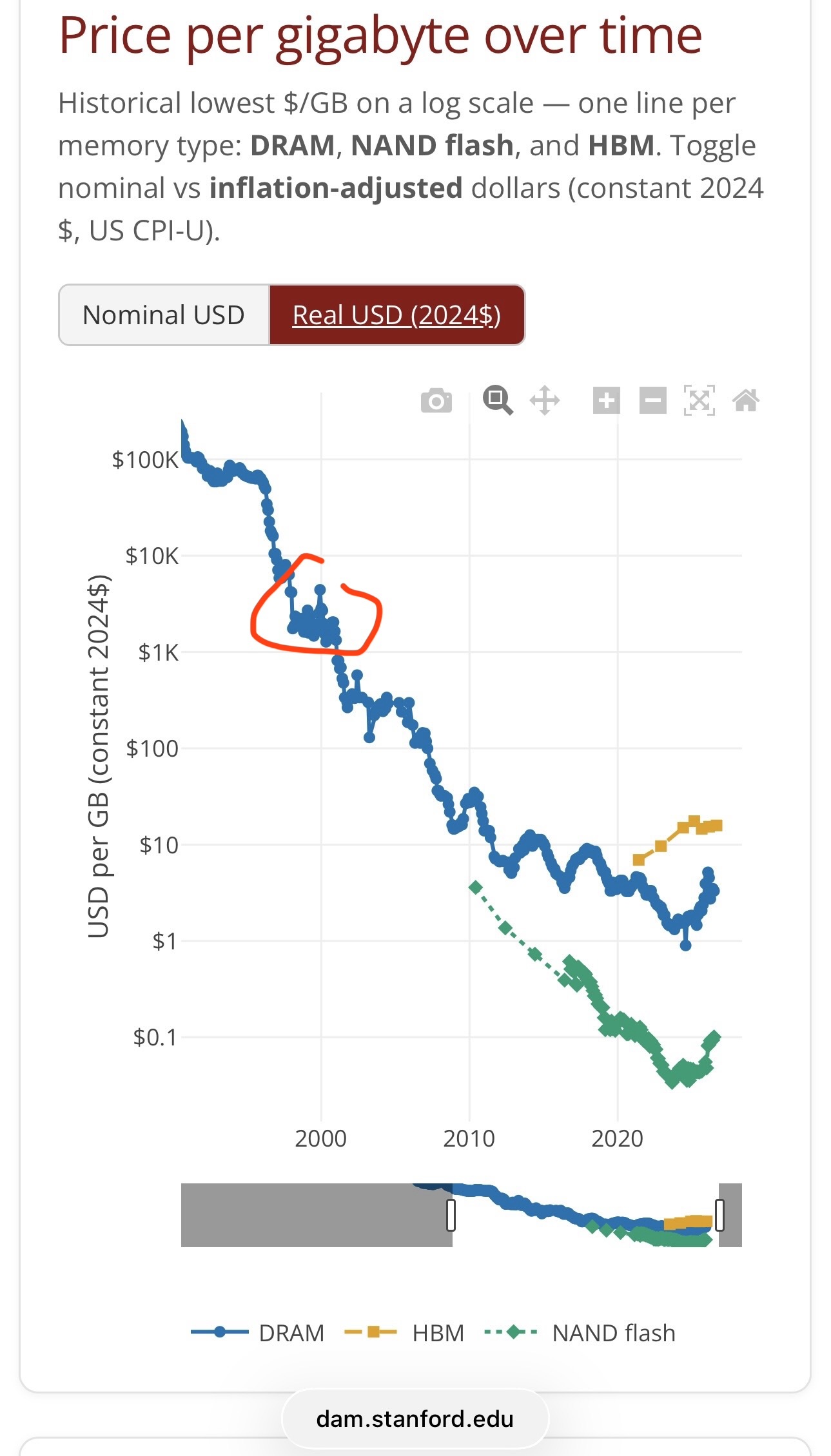
  • They have fixed prices before but that looked different. See the circled area on the graph where there had been declining RAM prices but that decline suddenly stopped and became really stable? That period of 1998-2002 is where Hynix, Infineon, Micron Technology, Samsung, and Elpida were all found to have been fixing prices on RAM because all the supply they were bringing online was crashing the prices but they hoped to collude with each other to keep the prices stable rather than continuing to decline in price competition.

    That coordination worked well for the way down (except when they got hit for hundreds of millions of dollars & euros in fees when it got discovered but eh), just a matter of agreeing on a number they all won’t go below. But how would they coordinate a continuous rise in lockstep with each other, that’s a LOT of phone calls anytime someone wants to buy? Why are many committing the billions of dollars to building new plants if they know that the only reason they’re making money hand over fist is avoiding selling product until it reaches a high price, why shell out money to bring supply up in that case? And why did their previous price fixing look only like a flat line if they were capable of having it go straight up? If they had that ability all along I don’t think you would have seen this somewhat sinusoidal graph with a sharply downward longtime trend for prices.


  • Just idle curiosity but are basements and underground structures more common in areas high up in the mountains or way up in the north like Hokkaido?

    In the American South we don’t usually have basements and they say it’s because you don’t need to dig down far to get past the frostline (whereas in our north they apparently have to dig down a fair distance to get to where the pipes wouldn’t freeze from below and once they’ve excavated that much you might as well get a basement anyway) and we also generally have high water tables that make basements dicey except in certain areas. My grandparents lived at the top of a hill on a plateau or ridge and unlike many people in the south they had a basement mostly cut into the slope of the hill (though it had a door leading out where the slope dropped down so maybe it doesn’t fully count), but even with the somewhat further down water tables there they constantly were running a dehumidifier in the basement due to the moisture and on occasion in heavy storms the walls would seep in water.